Before the Solution — a figure holding up a blank placard

A practical guide to the thinking that comes before the solution, written for designers, students, and anyone working with tools and AI.

"The first plausible solution is usually a map of your habits, not a map of the situation." (Chapter 5)

"You shape the world, and you shape yourself in the same act." (Chapter 2)

BEFORE
THE SOLUTION

Living Design Beyond Tools and Templates
The edition
EditionNovember  2026
Format220 x 170 · 196 pp
LanguageEnglish
ISBN9789063698126
From the back cover

process is not practice.

Design lives in everything that comes before the solution: how you sit with a problem, how you decide what to ignore, how you stay in charge when AI sits beside you.

Scroll

What makes you a designer? Surely following methods, using tools and filling templates is a part of it, but process is not practice. Design  is now practised through systems that take agency from the designer and produce results that look right but lack understanding.

But design lives in everything that comes before the solution. How you sit with a problem before reaching for a template. How you let an idea change the question instead of refining the answer. How you decide what to ignore, and how you stay in charge when AI sits beside you.

Producing solutions will keep getting faster and cheaper. Living with the problems, with AI, and with others is the part that stays yours. To keep it is to live as a designer, not just work as one.

Published by
BIS Publishers — Inspiring Creative Minds

Inside the
pages

A book made to be opened anywhere. Shapeshifters design studio have given it visuals that carry the argument rather than decorate it, and a form that invites you in at any page. No sequence to follow. Read a little, practise, return.

Read a sample
01
Chapter Five · title spread
Living with Problems
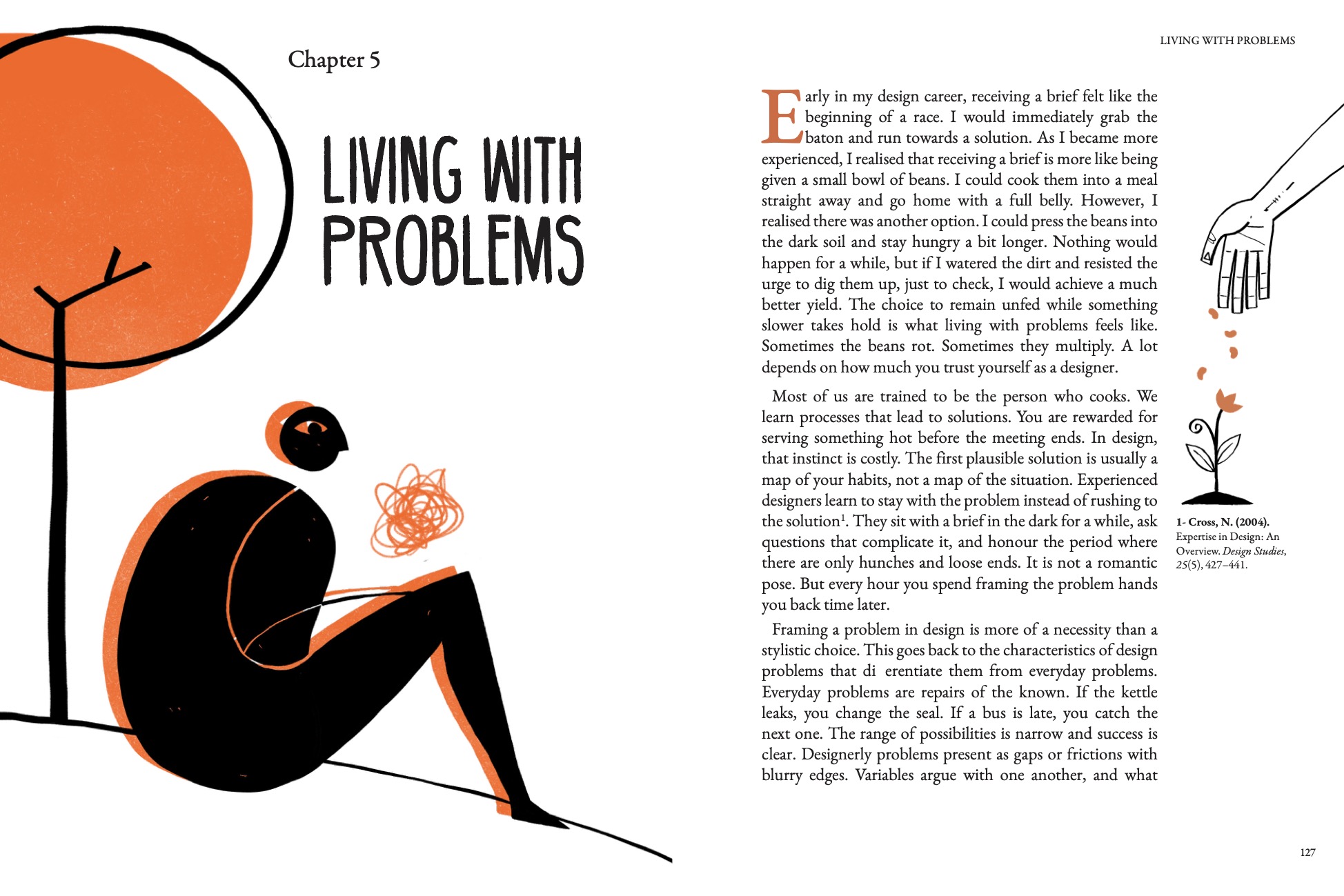
Chapter 5 title spread. Left page: a hand-drawn illustration of a seated figure with a spiral of thought beside its head, resting beneath a large orange tree, with the heading 'Chapter 5' and hand-lettered title 'LIVING WITH PROBLEMS'. Right page: the opening paragraphs of the essay, with an illustration of a hand dropping seeds into soil beside a sprouting plant, headed '5. LIVING WITH PROBLEMS'.
Early in my design career, receiving a brief felt like the beginning of a race. I would immediately grab the baton and run towards a solution. As I became more experienced, I realised that receiving a brief is more like being given a small bowl of beans. I could cook them into a meal straight away and go home with a full belly. However, I realised there was another option. I could press the beans into the dark soil and stay hungry a bit longer. Nothing would happen for a while, but if I watered the dirt and resisted the urge to dig them up, just to check, I would achieve a much better yield. The choice to remain unfed while something slower takes hold is what living with problems feels like. Sometimes the beans rot. Sometimes they multiply. A lot depends on how much you trust yourself as a designer. Most of us are trained to be the person who cooks. We learn processes that lead to solutions. You are rewarded for serving something hot before the meeting ends. In design, that instinct is costly. The first plausible solution is usually a map of your habits, not a map of the situation. Experienced designers learn to stay with the problem instead of rushing to the solution. They sit with a brief in the dark for a while, ask questions that complicate it, and honour the period where there are only hunches and loose ends. It is not a romantic pose. But every hour you spend framing the problem hands you back time later. Framing a problem in design is more of a necessity than a stylistic choice. This goes back to the characteristics of design problems that differentiate them from everyday problems. Everyday problems are repairs of the known. If the kettle leaks, you change the seal. If a bus is late, you catch the next one. The range of possibilities is narrow and success is clear. Designerly problems present as gaps or frictions with blurry edges. Variables argue with one another, and what counts as "better" depends on whose future you have in mind. Information is missing, and some of what you think you know is wrong in ways that will only show up when you move. You do not solve these as puzzles with a single answer. You frame a workable way to act.
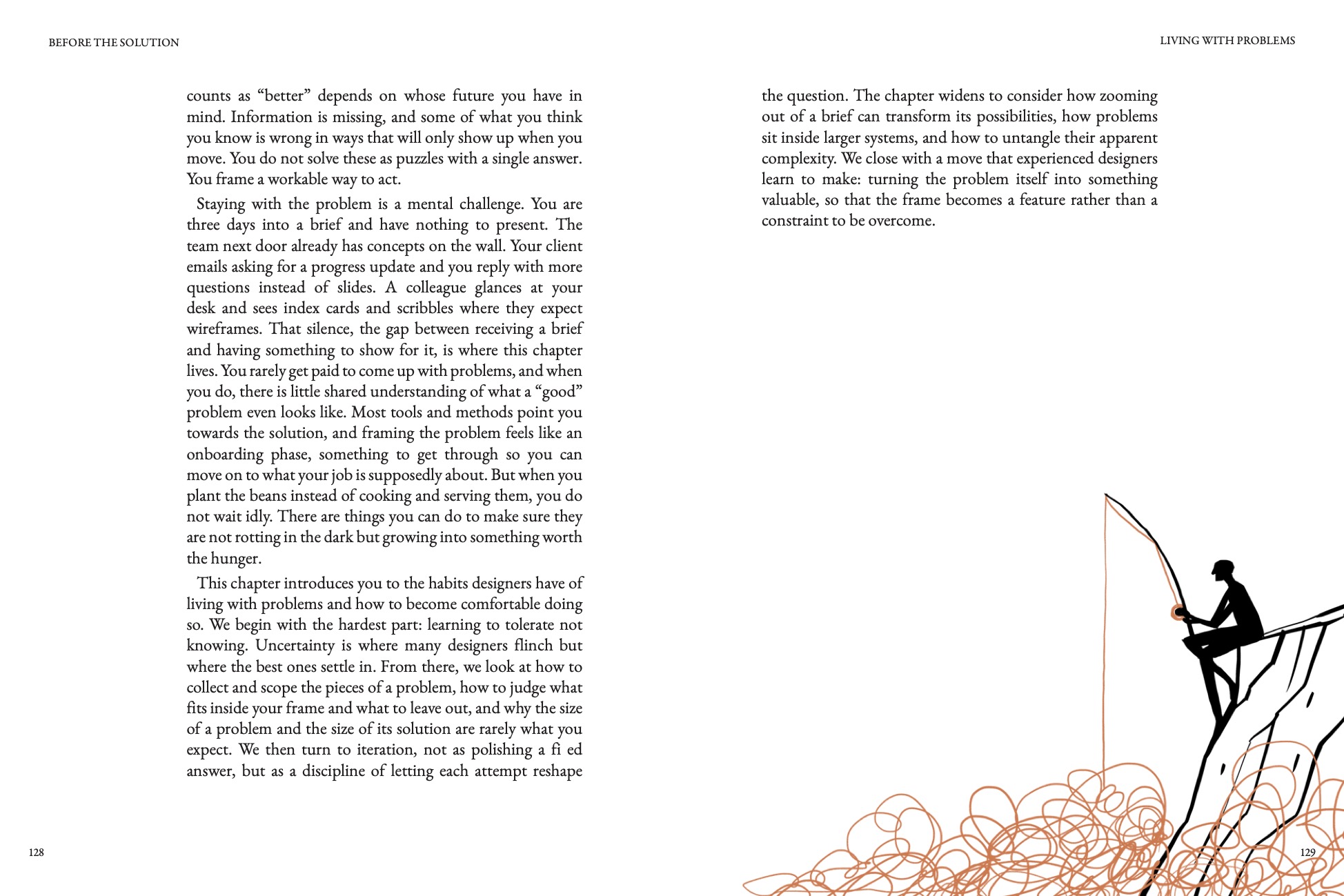
Chapter opening spread, continued. Left page: further paragraphs of the essay, describing the discomfort of sitting with an unresolved brief and closing with a preview of the chapter's structure. Right page: a small illustration of a scribble beside a closed eye, above a four-line Umar Khayyam quatrain about lifelong thought yielding only the realisation of knowing nothing, attributed to Umar Khayyam, Quatrain #93.
Staying with the problem is a mental challenge. You are three days into a brief and have nothing to present. The team next door already has concepts on the wall. Your client emails asking for a progress update and you reply with more questions instead of slides. A colleague glances at your desk and sees index cards and scribbles where they expect wireframes. That silence, the gap between receiving a brief and having something to show for it, is where this chapter lives. You rarely get paid to come up with problems, and when you do, there is little shared understanding of what a "good" problem even looks like. Most tools and methods point you towards the solution, and framing the problem feels like an onboarding phase, something to get through so you can move on to what your job is supposedly about. But when you plant the beans instead of cooking and serving them, you do not wait idly. There are things you can do to make sure they are not rotting in the dark but growing into something worth the hunger. This chapter introduces you to the habits designers have of living with problems and how to become comfortable doing so. We begin with the hardest part: learning to tolerate not knowing. Uncertainty is where many designers flinch but where the best ones settle in. From there, we look at how to collect and scope the pieces of a problem, how to judge what fits inside your frame and what to leave out, and why the size of a problem and the size of its solution are rarely what you expect. We then turn to iteration, not as polishing a fixed answer, but as a discipline of letting each attempt reshape the question. The chapter widens to consider how zooming out of a brief can transform its possibilities, how problems sit inside larger systems, and how to untangle their apparent complexity. We close with a move that experienced designers learn to make: turning the problem itself into something valuable, so that the frame becomes a feature rather than a constraint to be overcome. My heart was never deprived of knowledge. Few secrets remained unknown to me. For seventy-two years I thought, day and night, only to realise that I knew nothing. — Umar Khayyam, Quatrain #93
02
Inside the chapter · essay
Finding comfort in uncertainty
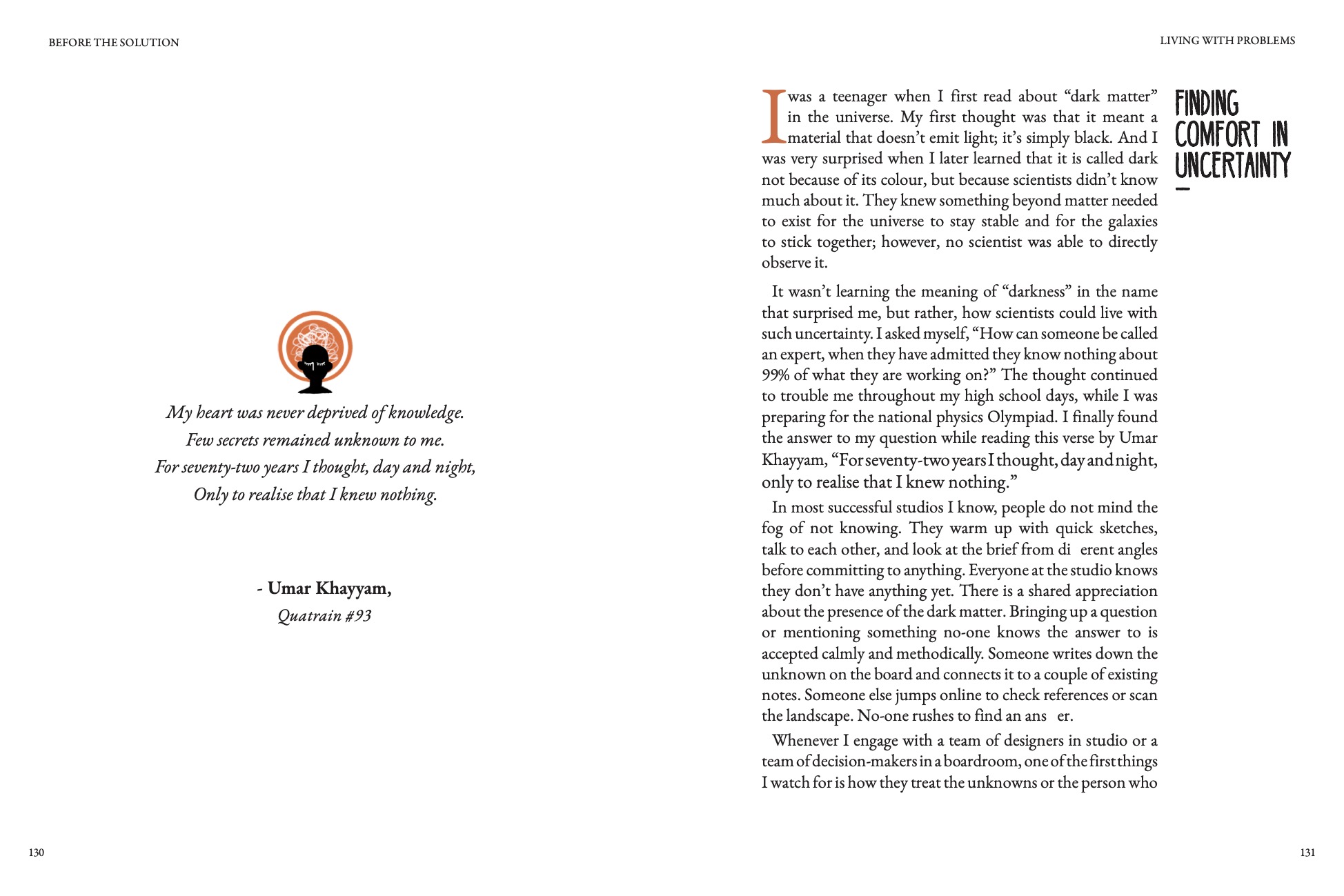
Interior essay spread titled 'Finding comfort in uncertainty', hand-lettered in the left margin. Left page: the opening of the essay recounting the author's teenage discovery of dark matter and the Umar Khayyam verse that answered his question about expertise and not-knowing. Right page: the essay continues on studio culture around uncertainty, Fritz Zwicky's 1933 discovery, the two kinds of unknowns (facts and values), and a small illustration of a lotus-like ink blot in the margin beside a note on identifying unknowns.
Finding comfort in uncertainty. I was a teenager when I first read about "dark matter" in the universe. My first thought was that it meant a material that doesn't emit light; it's simply black. And I was very surprised when I later learned that it is called dark not because of its colour, but because scientists didn't know much about it. They knew something beyond matter needed to exist for the universe to stay stable and for the galaxies to stick together; however, no scientist was able to directly observe it. It wasn't learning the real meaning of "darkness" in the name that surprised me, but rather, how scientists could live with such uncertainty. I asked myself "How can someone be called an expert, when they have admitted they know nothing about 99% of what they are working on?" The thought continued to trouble me throughout my high school days, while I was preparing for the national physics Olympiad. I finally found the answer to my question while reading this verse by Umar Khayyam: "For seventy-two years I thought, day and night, only to realise that I knew nothing." In most successful studios I know, people do not mind the fog of not knowing. They warm up with quick sketches, talk to each other, and look at the brief from different angles before committing to anything. Everyone at the studio knows they don't have anything yet. There is a shared appreciation about the presence of the dark matter. Bringing up a question or mentioning something no-one knows the answer to is accepted calmly and methodically. Someone writes down the unknown on the board and connects it to a couple of existing notes. Someone else jumps online to check references or scan the landscape. No-one rushes to find an answer. Whenever I engage with a team of designers in studio or a team of decision-makers in a boardroom, one of the first things I watch for is how they treat the unknowns or the person who brings them up; this tells me about their expertise. Some have become so good at avoiding the unknown and shutting down anyone who mentions it that they have created professional language around the dismissal: That's a "known unknown"; Let's stick to what we can control; Let's not speculate; That's outside the scope. I'm sure Fritz Zwicky didn't find out about the dark matter in 1933 by sticking to what he could see through his telescope. Instead, he looked outside his scope, speculated about what could be, let go of his sense of control, and admitted the existence of the unknown. In design, one gets used to not having all the answers. Fixating on an early solution to fill uncertain space is the biggest mistake you can make. This is not only a creative challenge, but also a cognitive one. Once someone decides a direction, everything that follows tends to conform to it. You stop noticing data that does not fit. You design for the first frame instead of testing whether it even deserves attention. Good studios manage this by keeping the beginning of a project open on purpose. They use it to shape the question, not the output. Recognising the presence of uncertainty is part of knowing. It is the dark matter that balances the space, whether it be the universe or the problem space. When a situation feels unclear, there are usually two kinds of unknowns in play. The first type of unknown, facts, are about the world: arrival rates, handling times, who does what and when, what people do rather than what they say. The second type, values, guide judgements: which trade-offs matter, who bears the cost, how will success be evaluated over months rather than days. If you do not separate these, you'll end up debating on what you should have measured and researching on what you should have decided. Nevertheless, the pressure for quick resolutions to avoid uncertainty is understandable in studio. Clients want momentum. Students want marks. Teams want to feel useful. Above all, the brain is wired to avert problems, a characteristic that is known as Need for Cognitive Closure. We dislike the uncertainty just as we dislike darkness. We have the urge to land on a firm answer quickly and stay there. To protect us from the uncomfortable unknown, the brain locks into the first plausible scenario and shuts down alternatives. We even opt for irrational options when the rational decision entails some ambiguity. You tend to privilege tidy data and sidestep the messy, often ignoring the material factors like culture, values, and politics. These cognitive biases towards finding a quick solution are not easy to overcome. Like every other cognitive skill, comfort with uncertainty is not a heroic trait. It is a habit that can be practised and taught. Some of us fixate early because not knowing feels like failing. If that is you, try choosing a private measure of progress that is independent of solutions. Instead of counting the ideas you generated, record how many contributing factors you have discovered, how many non-trivial connections you have made between them, and how many frames you have considered. Track the ratio of factual to value unknowns you resolved each week. Note when a new frame changed your mind. These are small, honest indicators that you are doing the work. Over time they make the discomfort bearable. A practice I often find useful in overcoming problem aversion, is to articulate the unknown and uncertain as some form of artefact. We are biased towards action, so movement feels better than reflection. I start by setting a small, explicit exploration of the problem space. Write things down. Sketch them. Make the connections visible. Collect precedents and inspirational materials. Activities like these will help you move within the problem space without leaving it. Do not dismiss the unknowns. Write them down and organise them. Like an astronomer charting dark matter in the invisible universe, seek patterns in the unknown parts of the problem space. Start with the two types, facts and values, but don't stop there. List the unknowns you could measure this week without heavy machinery. Then list the unknowns of value you need to surface through conversation and decision. Decide on a small probe for each item. A probe is a tiny action that trades an hour for clearer footing. Think of a quick shadowing session, a targeted call, a simple online search, a quick test, or a paper prototype. The point is not to be busy. The point is to learn what the situation is made of before you name its answer. You can enforce a quiet ban on answers the first hour of any new brief. You can separate your unknowns of fact from unknowns of value. Choose one probe for each to monitor within forty-eight hours. If you must use AI in that window, ask it only to argue with your frames or to find counterexamples. Then, for the rest of the week, put your favourite solution in your pocket. When someone asks what you are making, answer with a clearer problem sentence instead. At the end of the week, lay those sentences beside the original brief and look at how your understanding of the problem has changed. If it hasn't, you probably skipped the hard part. If it has moved for good reasons, you are learning to work in the presence of dark matter: not by ignoring what you cannot see, but by designing with the confidence that it is there.
What the book is about

Design is a deeply human capability, and it is increasingly practised through tools, templates, and AI that can generate polished solutions at speed and scale. The risk is a profession whose outputs look right yet lack depth, character, and humanity. If you have ever felt your process is “correct” but your outcomes are interchangeable, the gap is rarely in the tools. It is in what comes before them.

Before the Solution helps you build the practice between projects. Written for early-career designers and students, and useful to anyone in tool-heavy settings, it focuses on the part of practice you can train without a brief in front of you. How you sit with a problem before reaching for a template, how you let a prototype change the question, how you decide what to ignore, and how you stay in charge when AI is in the room.

The book is organised around six chapters on living with the recurring companions of design work, the discipline, the people, the problems, the solutions, the AI, and yourself. These are not stages to complete. They are vantage points to return to. Each is treated as a set of habits to build, with short narratives and distilled design-cognition research.

The distinction it draws is between design as production and design as practice. Methods and AI will keep getting better at production. Practice, the framing, the trade-offs, the intent behind a decision, is where designers still make the difference, and it is trainable.

Six ways to live with the work

Table of Contents

  1. 01

    Living with Design

    about the discipline

    This chapter chases a stubborn question. When is design actually happening? Not in the finished product, not in the tidy process, but in the way a person notices, connects, and judges. Design is the most human of our capabilities, less a profession than a way of moving through the world, and it starts long before the solution does.

  2. 02

    Living with Yourself

    your own judgement and habits

    About the unbilled hours between briefs, the deliberate work of building the designer you will need before the work arrives. Software dates. Methods expire. The way you think travels with you. A designer, it turns out, is made rather than found.

  3. 03

    Living with Others

    the people in the work

    Design is almost always for other people, and this chapter sits in that gap, the distance between where a designer stands and the life they are designing for. Empathy has limits we rarely admit. You cannot cross that distance. You can only keep reaching across it, honestly, without pretending you have arrived.

  4. 04

    Living with AI

    staying in charge when AI is in the room

    Not an argument against AI. It is here, it is powerful, and we will be living with it. The real question is what we hand over, speed and scale on one side, closeness to the problem on the other. Some work you want done. Some work you want to do.

  5. 05

    Living with Problems

    framing before solving

    Makes the case for the unknown, for staying with a problem long enough to frame it well rather than rushing to the first plausible answer, which is usually a map of your habits and not of the situation. The hunger is uncomfortable. The yield is worth it.

  6. 06

    Living with Solutions

    holding outcomes lightly

    Looks at solutions from an angle that never runs out. A solution is not the end of a problem but part of its context, the starting point for someone else’s brief. Markets saturate. Design problems do not.


Dr Morteza Pourmohamadi
About the author

Dr Morteza
Pourmohamadi

Dr Morteza Pourmohamadi is an award-winning design educator, leader, and researcher whose work sits at the intersection of design practice and design cognition. He holds a PhD in Design Computing and Cognition from the University of Sydney, where he currently teaches design studios. Over two decades of university teaching, he has taught thousands of students.

Beyond teaching, he has worked with governors, academic leaders, entrepreneurs, and business owners, helping them navigate complex challenges through creativity, design, and systematic thinking. He founded Iran’s first Faculty of Design, developed products and services, and helped startups realise their vision.

His research on design protocol studies and computational models of design cognition has been published in peer-reviewed journals and conferences. Before the Solution is his first book, drawing together two decades of practice and research into habits designers can train between projects.

Practice is not process.
It is what you do before the solution.
PublisherBIS Publishers
ISBN9789063698126
Format220 × 170 mm
Extent196 pages
LaunchNovember 2026
AudienceDesign students, early-career designers, educators, and tool-heavy creative teams
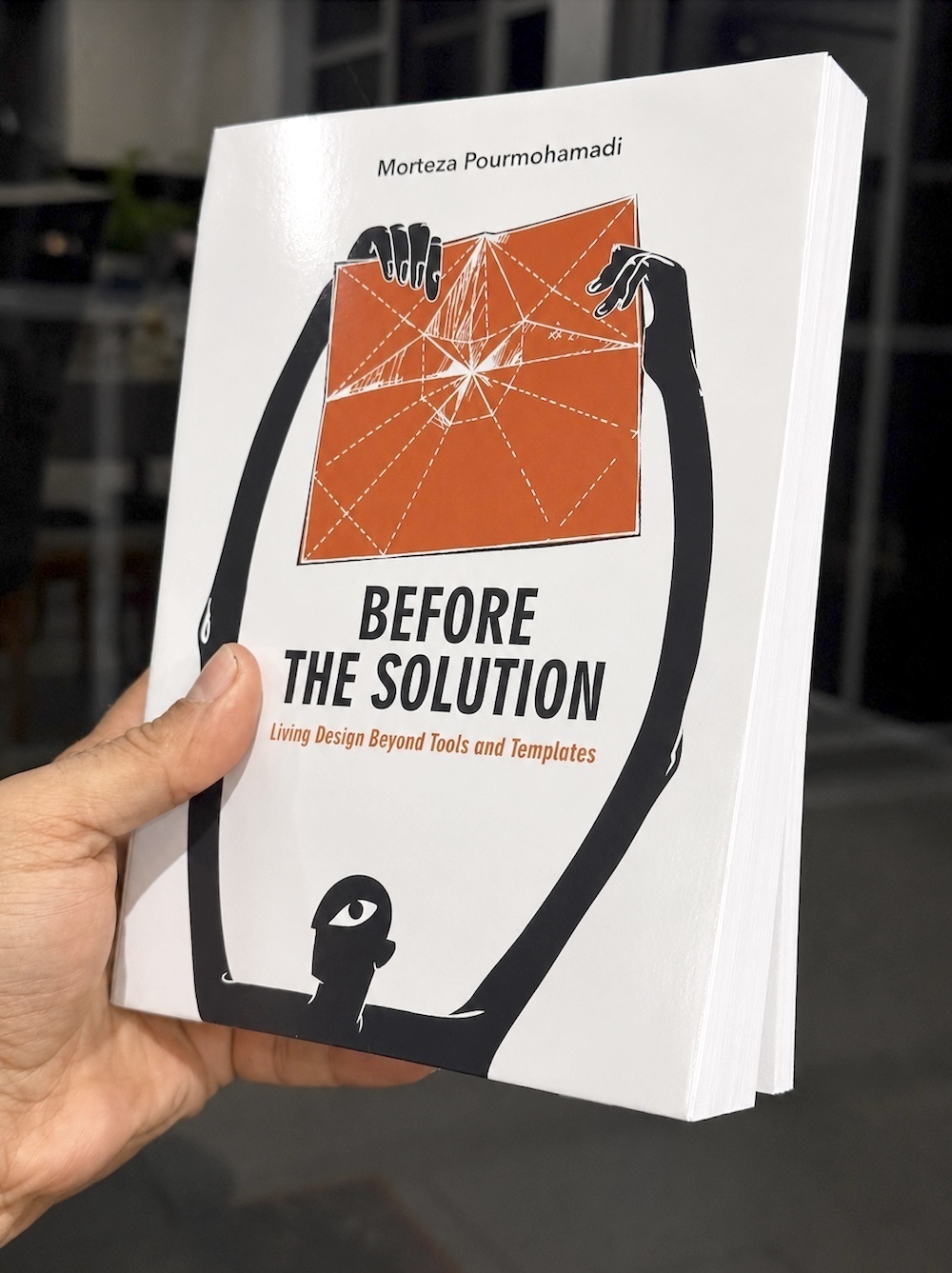
Before the Solution — paperback held in hand
Follow the book to launch

Publication news, author talks and seminars, and notes on practice.

You’re on the list.

Something went wrong, please try again.